A very different perspective on the previous questions occurs to me.
A friendly theologian explained to a member of the housegroup the difference between the assumptions made by scholarship and the assumptions made by faith. Hence, the confessing student approaches the text with the general assumption of truth; the unbelieving - or sceptical - mind-set requires proof.
And that in turn reminded me of a contrast someone made between the Oxford Theology Faculty - which sets out to be academic and objective - and the confessing faculties of some Universities, particularly (when mentioned) those in Switzerland. In the latter, we would find a generally very different approach to these questions. Indeed, the point was made that in the Oxford faculty, the question "how would the Catholics approach this" is a good one; in the Protestant confessing faculty in Geneva, the same question would be inadmissible and irrelevant.
And I'm left wondering which actually makes for better scholarship. The scientist in me says that the approach which is sceptical and aspires to be objective is best. But I wonder if that extends generally. Let us leave aside silly arguments about scepticism in the study of anthropogenic climate change. I wonder how many non-socialists you find studying Marxist economic theory. I wonder how many misogynists you find in women's' studies. I wonder how many Platonists you find studying intuitionistic logic. And so much else besides.
I may be mistaken, but we tend to assume that people are allowed to hold worldviews consistent with the research they undertake. But for students of religion it's not so good. Or is it?


2010/09/27
oh my
I used to have a lot of respect for Gerald Coates - whacky house church/'new churches' leader as he was. I haven't heard anything of him for years. Then I saw this (h/t The Register) which, I'm afraid, is too bizarre by half. Even if the newspaper story is half made up, as most seem to be, it doesn't sound good.
2010/09/26
faith and doubt and scholarship
At our homegroup last week, we watched a lecture about the Old Testament, by a Dr Amy-Jill Levine. This was the introduction to a long series - which we may or may not watch - so she was setting out her whole perspective. This involved discussing the various kinds of literature in the OT, and briefly touching on their literary influences and historical/archaeological evidence.
In one sense, it was unremarkable stuff. A little dated in places, but nothing you wouldn't hear in a run-of-the-mill theological college. Even though she advanced her own opinion that King David didn't necessarily exist as a real historical figure, I'd say that her perspective wasn't really more radical than you'd hear even in a fairly evangelical school (but I may be wrong, because I don't tend to hang out in theological colleges).
But those are things you don't hear from the pulpit in an evangelical church. Describing the early chapters of Genesis as 'myth' is a bit of a red rag to people accustomed to thinking that believing the bible is God's word means believing that everything which seems like it might be history is ... well, a forensic account worthy of Simon Schama, or Lord Dacre, or whoever your favourite historian might be. Suggesting that it might not have been written down until the time of the Exile, that as a result its account of events a thousand or more years earlier might be patchy, is liable to evince harrumphs and bristly responses. Suggesting that the early chapters of Genesis have material in common with the myths of Babylon, and the former might have been written in knowledge of the latter, is tantamount to some awful crime.
Where did it all go wrong? How did receiving the bible as God's word come to mean leaving hold of our critical faculties? If there's scant extra-biblical evidence for the Exodus, does it really destroy our faith to say so? Can you really read the book of Judges as if it were written according to the literary conventions of enlightenment Europe? Would it be so bad to fess up and say that Job and Jonah have more in common (in terms of historicity) with Falstaff or King Arthur than Queen Victoria or Winston Churchill?
Is that kind of doubt destructive? I don't think so. In fact, I think it's essential. Creation versus evolution has become the totemic issue for scholarship versus 'literal' biblical interpretation, but the same kind of issues arise over and over again. That's not to say that the scholarship should be accepted uncritically - a lack of archaeological evidence is not at all the same thing as a 'proof that it never happened'. But if Christian piety remains detached - and divergent - from the best high-quality thinking about its own core text, then it can only be impoverished, naive, and irrelevant. Can't it?
In one sense, it was unremarkable stuff. A little dated in places, but nothing you wouldn't hear in a run-of-the-mill theological college. Even though she advanced her own opinion that King David didn't necessarily exist as a real historical figure, I'd say that her perspective wasn't really more radical than you'd hear even in a fairly evangelical school (but I may be wrong, because I don't tend to hang out in theological colleges).
But those are things you don't hear from the pulpit in an evangelical church. Describing the early chapters of Genesis as 'myth' is a bit of a red rag to people accustomed to thinking that believing the bible is God's word means believing that everything which seems like it might be history is ... well, a forensic account worthy of Simon Schama, or Lord Dacre, or whoever your favourite historian might be. Suggesting that it might not have been written down until the time of the Exile, that as a result its account of events a thousand or more years earlier might be patchy, is liable to evince harrumphs and bristly responses. Suggesting that the early chapters of Genesis have material in common with the myths of Babylon, and the former might have been written in knowledge of the latter, is tantamount to some awful crime.
Where did it all go wrong? How did receiving the bible as God's word come to mean leaving hold of our critical faculties? If there's scant extra-biblical evidence for the Exodus, does it really destroy our faith to say so? Can you really read the book of Judges as if it were written according to the literary conventions of enlightenment Europe? Would it be so bad to fess up and say that Job and Jonah have more in common (in terms of historicity) with Falstaff or King Arthur than Queen Victoria or Winston Churchill?
Is that kind of doubt destructive? I don't think so. In fact, I think it's essential. Creation versus evolution has become the totemic issue for scholarship versus 'literal' biblical interpretation, but the same kind of issues arise over and over again. That's not to say that the scholarship should be accepted uncritically - a lack of archaeological evidence is not at all the same thing as a 'proof that it never happened'. But if Christian piety remains detached - and divergent - from the best high-quality thinking about its own core text, then it can only be impoverished, naive, and irrelevant. Can't it?
2010/09/13
Is There a Future for Evangelicalism?
Jonathan D. Fitzgerald asks this question over the Huffington Post. It's a shame he has an almost entirely US-centric answer - it half-defeats the point of the question, I'd say.
2010/09/11
review: Enemies of Reason
 Review: Enemies of Reason / Slaves to Superstition
More 4/Richard Dawkins
Channel 4 has a series in homage to, and presented by, Richard Dawkins. I think some or all of it is repeated, but I didn't see it first time around. Earlier episodes featured his now-familiar criticism of religion, and Christianity in particular.
Now, I'm watching a recording of a later episode on Slaves to Superstition. He's been chasing down and ridiculing horoscopes, spiritualism, dowsing, conspiracy theorists, and more, with his familiar blend of scepticism and scientism. He explains the benefit of believing verifiable evidence over private feeling.
And I'm inclined to agree with him. Every bit. Science offers us strong, valuable insight into our world's systems. It has advanced medicine beyond the wildest dreams of our ancestors. All this random spiritualism is largely flim-flam, with no substance and no real benefit - no impact beyond what you'd expect from random processes. Indeed, this line came from the middle of the programme:
Even in the 21st century, despite all that science has revealed about the indifferent vastness of the universe, the human mind remains a wanton story-teller, creating intention in the randomness of reality.
The whole thing is a bit of a hymn to rationalist enlightenment thinking,without a hint of any cracks in the edifice. His calm rational interviews of spiritualists, exposing their bizarre nonsense, is of course amusing. That their ways of thinking may give comfort and help is discarded: founded on nothing at all, their influence can only be malign. I think I agree.
And so two things bother me:
- for what good reason do I think that Christian faith is any different?
- is Richard going to be intellectually honest enough to ask whether the same purblindness afflicts the scientific community? It's much easier to build a theory based on the convenient data, and discard that which doesn't seem to fit. I don't suggest that a major scientific calumny is being committed - but I have to wonder whether it is more of a common human trait to discard the evidence that doesn't fit.
2010/08/30
review: Re-enchanting Christianity
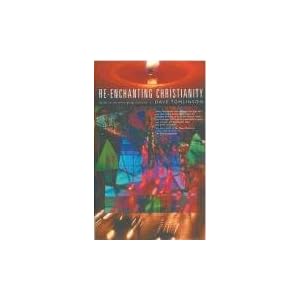 Re-enchanting Christianity: faith in an emerging culture
Dave Tomlinson
I love this book. So much of the serious thinking about emerging things has come from a USA context. Most of the UK contribution has been around the alt.worship perspective, rather than creative thinking about understanding the faith itself in the 21st century (I over-generalize, of course). However, Tomlinson is decidedly British, and writes a very engaging account - in a popular theology sort of way - of a constructive but genuinely up-to-date way to understand following Christ today.
If I carry on my generalized sweeping statements, his book The Post-Evangelical was about things that were going wrong with the evangelical church; this book is the counterpart describing where we might go instead. The writing is approachable: theological, but grounded on Tomlinson's own experience, and showing the wisdom which comes from his own pastoral ministry. Of course, this isn't a work of deep theology - I struggle with those - but here you will find lots of references to Moltman, Crossan, Borg, Ward, Wink, and others. Tomlinson has done his homework.
I quoted previously two stand-out quotes from the book. They do give quite a good sense of the kind of narrative you should expect. That seems to have been a long time ago: I needed to revisit the book after the first read, before reflecting on it.
This is not a book for the faint-hearted. Those who are new to asking difficult questions about Evangelical faith will either dismiss it as liberal nonsense or will find their minds well and truly blown. As for me, I believed in the historicity of the Virgin Birth when I started the book, and now, meh, I rather doubt it. It just kind-of evaporated, as I read Tomlinson's discussion of how we might hold on to the mystery through metaphor rather than through historical interpretation.
And the key is that here we are not presented with some nihilist deconstruction of all that we have held dear, but rather something which is overwhelmingly constructive - as the title suggests. Tomlinson is looking for ways that historical texts - and the Spirit of God - can speak to our present era, remaining true to both. His final paragraph is this:
Christian mission in the twenty-first century requires kingdom-oriented communities, places of radical inclusion and empowerment, which say: You are welcome - whatever your ethnic or cultural background, however you look or dress, whether you are a man or a woman, gay or straight, whether you earn a pittance or you're worth a fortune, whether you have kids, can't have kids, don't want to have kids, whether you are full of faith or riddled with doubts, whether you feel hopeful or fearful. Gregarious or withdrawn - YOU ARE WELCOME.
That's as good a summary as any of the church - the kingdom values - he's been describing in the book. It's all rather wonderful.
2010/08/22
review: The Joneses

Flying from Sydney to London offers lots of opportunities for watching in-flight movies (over and over again): so here's a film I wouldn't otherwise have watched...
[mild spoilers apply: don't read on if you're easily upset about learning movie plots before seeing the movie; having said that, I'm not really giving all that much away]
The Jones are a model family: we first meet them moving into an idyllic community and getting to know their neighbours. All seems a little too good for a while: but we quickly learn that this veneer is not all it seems: the Jones are actually unrelated to each other; they are a 'family' manufactured by a marketing company in order to promote products to their unsuspecting neighbours. They work by product placement, by encouraging others to push their products, through exquisite parties, through always having the latest and best stuff.
Here, then, is a 'family' at the apogee of consumerism: driven by nothing whatsoever except conspicuous consumption designed to engineer jealousy - and sales. All goes well for a while, then tensions mount
and, as befits a black comedy, the consequences spiral out of control. Tragic events lead some of the characters to reconsider what's important in life - without really concluding that consumption is of itself problematic - as befits a Holywood movie.
The plain 'message' is thought-provoking enough, though falling short of any sort of call to radical action. The mischevious thought that occurs to me, though, relates to the similarities we might see between the Jones's lifestyle marketing, and what some have called lifestyle evangelism. The Jones become apparent friends with many, look out for people of power and influence, and hold memorable parties with the intention of showing off all that's glitzy and expensive in their marketer-designed home.
That really doesn't sound so different to some 'evangelism strategies' we might encounter. Ok, churches don't go to the lengths of manufacturing fake families to achieve this (why bother, when you can be in the business of helping create the real thing), and would indeed eschew falsehood. Well, officially false testimony is out of the question, but there are all kinds of things which tread that line pretty close: whether friendships purely made with ulterior motives, or a variety of 'bait and switch' techniques like 'questionnaire evangelism'.
The Joneses are living the dream - till 'Mr Jones', at least, wakes up from it. May we live the truth, instead.
Subscribe to:
Posts (Atom)